In this article, we explore the history of engineered wood flooring and examine the advantages and disadvantages of the different types of support layers available today.

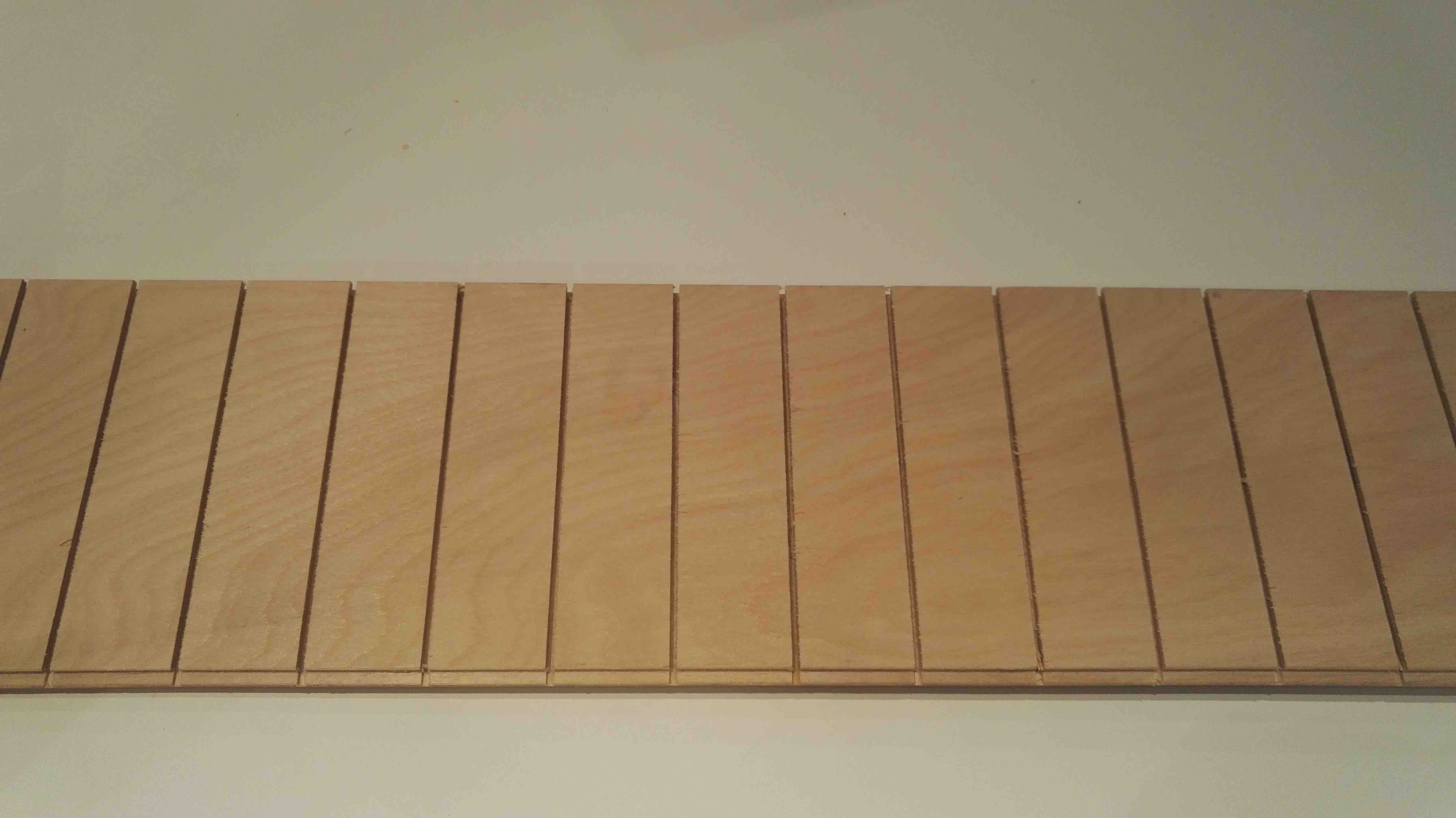
Two-layer engineered parquet: the support layer
Engineered wood is already… finished!
The introduction of engineered wood flooring has revolutionized the world of wooden floors, as it allows the installation of a product that is already finished and therefore does not require on-site sanding or finishing.
In the provinces of Vicenza and Verona, we have been installing engineered wood flooring for over 30 years, and it has now almost completely replaced traditional unfinished solid wood floors.
Why is it more in demand?
In this article, we aim to understand the reasons why engineered wood flooring has become the dominant choice today and why the market has moved in this direction. We will see that not all engineered floors are the same, even if they may look similar at first glance. We will learn that there are different ways to construct an engineered floor and discover which construction methods are best. Among the many questions we will address is a key one: which support layer is the best?

The advantages of using wooden flooring
The perfect floor throughout history
Wood has always been considered an excellent building material. As early as the Neolithic period, floors in dwellings were covered with branches and rough wood.
Why?
Because its natural qualities—warmth, strength, and comfort—have been appreciated since ancient times.

Why wood is still chosen today
Beyond the aesthetic appeal it gives to those who live in the space, the advantages of choosing wood flooring are well known:
- good resistance to wear,
- excellent thermal insulation,
- very good acoustic performance,
- natural elasticity,
- a good value-for-money ratio, and
- easy maintenance which, if carried out properly, preserves its functionality over time.
Not to be overlooked is the possibility of restoring the floor several times through sanding followed by refinishing or oil treatment.
From solid wood to engineered multilayer flooring
Originally used in the most prestigious homes and noble palaces, wood flooring was produced in its raw, solid form and installed and finished using artisanal techniques.
Over time, market demand and the evolution of manufacturing processes and technologies led to the development of increasingly stable and high-performing parquet floors, culminating in today’s modern engineered multilayer flooring. These products successfully combine the beauty of natural wood with contemporary requirements for speed, precision, stability, durability, and compatibility with modern building systems.
But before exploring the characteristics of engineered flooring, let’s take a step back and look at the history that brought us to this point.
Dettagli
Solid wood flooring and engineered parquet: two eras compared
For many decades, when people talked about wooden floors, they were referring almost exclusively to unfinished solid wood, supplied as raw boards to be installed, sanded, and finished directly on site. Today, however, the market is dominated by engineered multilayer parquet, already sanded and finished in the factory.
This transformation was not accidental, but the result of a technical, cultural, and environmental evolution that has profoundly changed the way we build and live in our homes.
Solid wood flooring: tradition
Solid wood flooring originated as a handcrafted solution. The boards, made entirely from a single noble wood species, were installed unfinished—nailed or glued—and then sanded and treated on site. This type of parquet characterized historic palaces, noble residences, and prestigious homes for centuries, especially in Europe.
Solid wood offered great freedom of customization, but it required:
- long installation times
- complex and dusty job sites
- strong dependence on the installer’s skill
- greater sensitivity to humidity and climatic variations
It was a “living” floor—fascinating, but also more difficult to manage.
The birth of engineered parquet: when and where
Engineered multilayer parquet emerged in the second half of the twentieth century, particularly between the 1960s and 1970s, in Northern Europe—especially in Germany and the Scandinavian countries.
Here, climatic conditions, the widespread use of domestic heating, and a strong industrial culture encouraged the search for solutions that were more stable, predictable, and standardized than traditional solid wood.
The revolutionary idea was to separate aesthetics from structure:
- a top wear layer in precious wood
- one or more support layers designed to ensure stability
The result was a parquet floor already finished in the factory, ready to be installed.
Why engineered parquet replaced solid wood
The success of engineered parquet was not immediate: initially it was viewed with suspicion by wood purists and, paradoxically, it often cost more than solid wood because it was the result of advanced technologies and complex manufacturing processes.
Over time, however, its advantages became clear:
- greater dimensional stability
- better compatibility with underfloor heating
- faster and cleaner installation
- more resistant and uniform factory finishes
Engineered parquet proved to be better suited to the needs of modern construction, with its demand for predictable timelines, faster job sites, and increasingly energy-efficient homes.
Why installers prefer it
From the installer’s perspective, engineered parquet represents a major shift:
- it eliminates on-site sanding
- it drastically reduces dust and noise
- it allows for faster, more predictable installation
- it reduces the risk of post-installation disputes
The result is a more controllable job, with fewer unpredictable variables and more consistent final quality.
Why end users choose it
For homeowners as well, the advantages are clear:
- the home is immediately usable after installation
- no lingering odors from finishes
- greater surface resistance
- simpler maintenance
Engineered parquet has made wooden flooring more accessible—not only economically, but also culturally—bringing it within reach of a broader audience.
Environmental aspects: solid or multilayer?
From an environmental standpoint, engineered parquet offers an often-overlooked advantage: it uses less noble wood for the same finished surface area.
This means:
- more efficient use of raw materials
- reduced impact on forests
- greater sustainability when sourced from certified supply chains
Solid wood remains a noble choice, but it is less efficient in terms of resource use.
Living comfort and long-term performance
In terms of living comfort, both solutions provide warmth and a pleasant feel underfoot, but engineered parquet offers:
- greater long-term stability
- fewer seasonal gaps
- more predictable behavior
This aspect is especially important in contemporary homes, which are often highly insulated and equipped with radiant heating systems.
Wooden flooring: recent innovations
The invention of lamparquet
The first wooden floors laid according to precise patterns and geometries date back to the Roman Empire. Since then, much has changed. One of the most important innovations—which enabled the widespread adoption of wooden flooring—came in the 1960s with the introduction of a standard format for solid wood flooring known as lamparquet. This term refers to solid wood elements approximately 1 cm thick, with dimensions of 60 × 300 mm.

The multilayer revolution
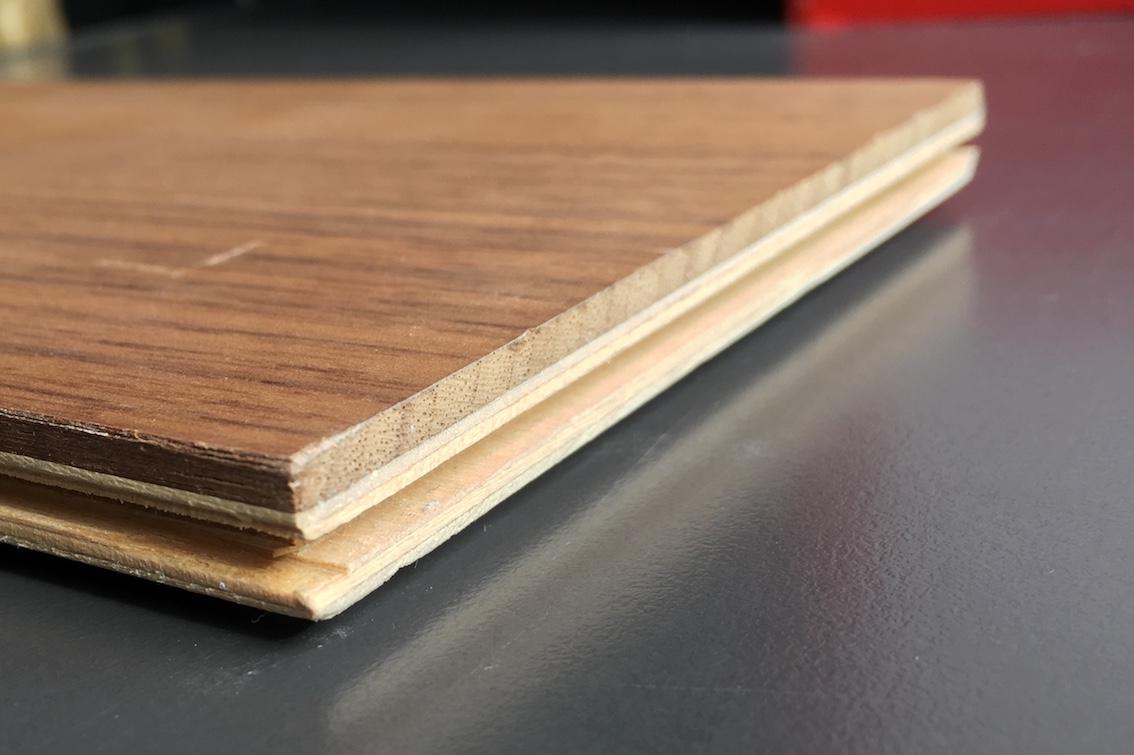
It was in the 1980s that wooden flooring underwent a true revolution with the introduction of two-layer engineered parquet. Traditional solid wood was replaced by a two-layer structure:
- the wear layer – the visible, noble wood surface –
- and the support layer.

Engineered multilayer wood flooring: reasons for its success
This innovation, initially introduced as an alternative to solid wood flooring, became widespread for several reasons ranging from cost efficiency to installation speed. Let’s take a closer look.
Lower cost
Solid wood flooring has a high cost, and by reducing its thickness it is possible to lower the final price. Even before the rise of engineered multilayer flooring, attempts had been made within the solid wood sector to reduce board thickness in order to cut costs. However, when thickness was reduced too much, the floor tended to deform. With engineered multilayer flooring, this problem is overcome: a very thin layer of “noble” (solid) wood can be used by bonding it to a stable support layer.
Fewer post-installation issues
Another key factor behind the success of engineered flooring is the near-total absence of disputes and problems related to on-site finishing and varnishing. Varnishing solid wood floors on site is an operation that rarely achieves the same level of precision as factory-applied finishes. Moreover, when purchasing engineered flooring, the client can immediately see what the boards will look like, whereas with unfinished solid wood this was only possible at the very end of the work.
More uniform appearance
Because engineered flooring is already finished, the installer can immediately see the final appearance of the wood and arrange the boards taking into account color variations and grain patterns. With solid wood flooring, any color inconsistencies only become visible after varnishing is completed—something that end clients may not understand or appreciate.
Faster installation
Timing is another reason for its success. Installing solid wood flooring could take around 30 days from the moment the first board was laid to completion. This was due to the many operations required after installation: sanding, filling, and applying multiple coats of finish. With engineered multilayer flooring, installation simply involves gluing the boards in place—job done.
Compatibility with radiant heating systems
A further important factor is the development and spread of radiant floor heating systems. This type of heating places stress on wooden floors, as it dries the wood fibers and causes expansion and contraction. Two-layer engineered flooring helps in this respect as well, as its construction limits wood movement and reduces internal stress.
Dettagli
Wooden flooring in European history
Primitive eras: wood as a necessity
In the earliest civilizations, wood was used for flooring out of functional necessity rather than for aesthetic reasons. Rough planks or split logs were laid directly on the ground or on raised structures to provide insulation from moisture and cold. There were no patterns or selections: wood was a readily available, local, non-decorative material. Protection relied on smoke from hearths, animal fats, or simply on continuous use.
The Roman world: wood as structure, not decoration
In the Roman Empire, wood was used mainly as a structural element (floors, decking) or as a base for other coverings. In wealthier domus, the “noble” floors were made of mosaic or marble, while wood was used on upper levels or in service areas. Boards were laid straight, without complex patterns, and protected with natural oils and waxes. Maintenance was continuous and entirely manual.
The Middle Ages: functionality and simplicity
During the Middle Ages, wooden flooring became more widespread in homes, castles, and monasteries, especially in the colder climates of Northern Europe. Boards were wide, irregular, laid parallel, and fixed with nails.
There was no decorative intent: the value of the floor lay in its robustness. Protection was achieved with oils, fats, and sometimes sand rubbed into the surface to absorb dirt. The color of the floor was the natural tone of the wood, darkened over time by use and wear.
The Renaissance: the birth of parquet
With the Renaissance, wooden flooring completely changed its role: from a purely functional element, it became a means of representation. In Italy, France, and European courts, the first geometric parquet floors appeared, laid with small wooden elements.
Patterns such as:
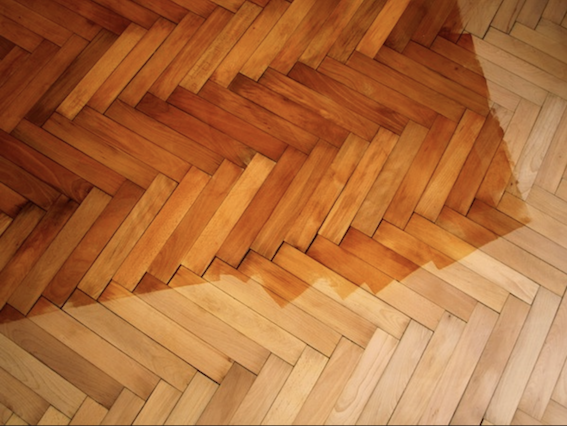
- herringbone,
- square panels,
- geometric interlaces
became widespread. Wood was carefully selected, sometimes combining different species to create chromatic contrasts. Surfaces were treated with natural waxes, hand-polished, and meticulously maintained.
Palladian villas: order, proportion, material
In the villas designed by Andrea Palladio, wooden floors followed architectural principles of order, symmetry, and proportion.
Parquet floors were sober yet refined, often featuring:
- regular boards,
- controlled geometric layouts,
- designs that dialogued with the building’s plan.
Wood was never excessive, but harmonious. Protection was provided by waxes and oils, periodically renewed.
Baroque and great monarchies: the floor as a stage
With the Baroque period and the rise of the great European monarchies, parquet became spectacle. In royal palaces such as Versailles, complex parquet floors emerged, featuring:
- star patterns,
- rosettes,
- floral motifs,
- polychrome inlays.
Precious woods sourced from around the world were used. The floor became a decorative canvas, a symbol of power and wealth. Maintenance was entrusted to dedicated teams, with frequent waxing, polishing, and continuous repairs.
Saint Petersburg and Eastern Europe: splendor and inlay
In the imperial palaces of Saint Petersburg, parquet reached extraordinary levels of refinement.
Here, floors were developed that were:
- fully inlaid,
- decorated with figurative motifs,
- characterized by strong chromatic contrasts.
Parquet became an integral part of the decorative scheme, together with stuccoes, frescoes, and furnishings.
Belle Époque: bourgeois elegance
Between the late nineteenth and early twentieth centuries, parquet became a permanent feature in bourgeois homes.
The following patterns spread widely:
- French herringbone,
- Hungarian herringbone,
- decorative square panels.
The floor was a sign of status as well as comfort. Surfaces were carefully maintained, glossy, and protected with waxes and shellac.
Between the two World Wars: rationality and industrialization
In the period between the two World Wars, parquet began to simplify. More standardized formats appeared, installation became faster, and decorative elements were reduced.
The aesthetic grew more rational, in line with modern architecture. Wood remained a noble material, but less celebratory. The transition toward more industrial production slowly began.
Industrial varnishes also started to be used to protect wooden floors.
Engineered wood flooring: the “wear layer”
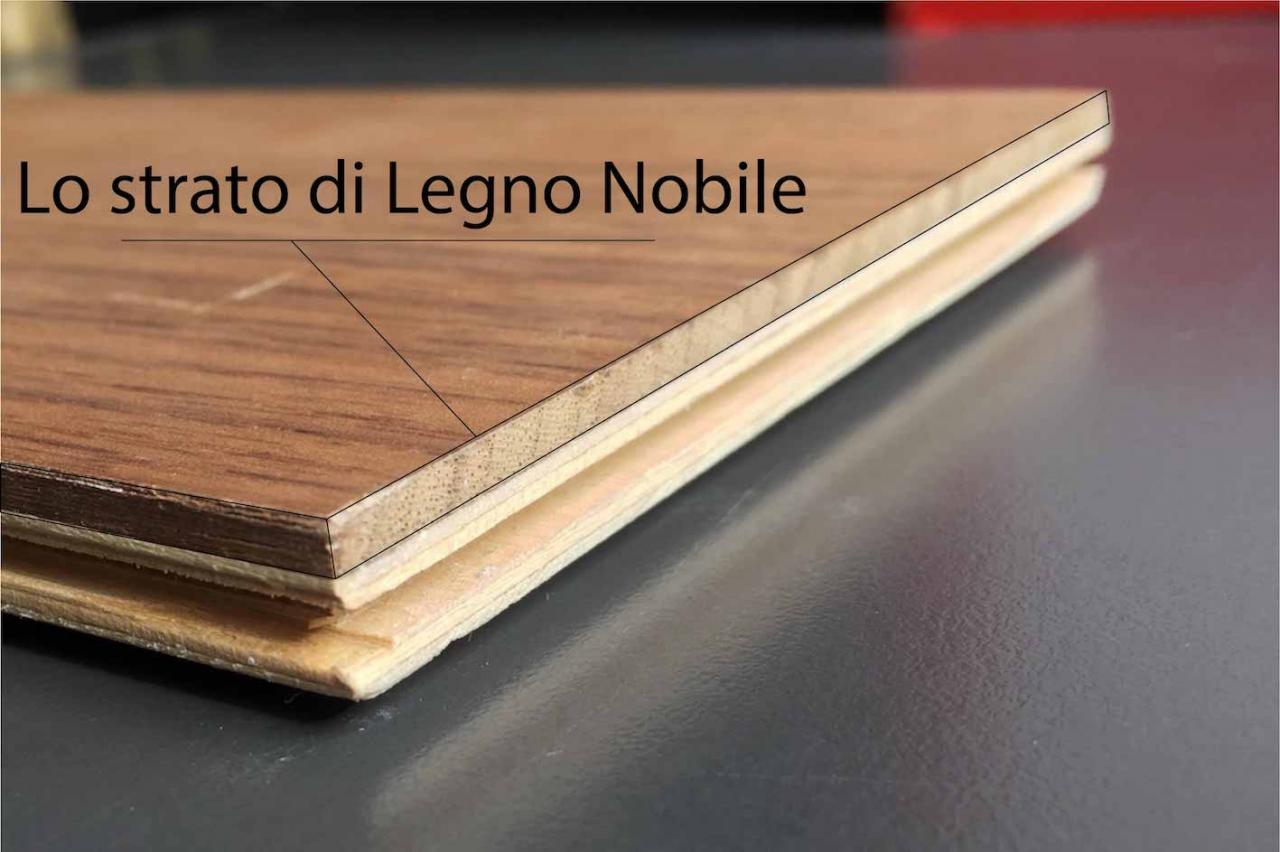
The wear layer is what you see
The top layer of engineered flooring, the so-called wear layer, is made from high-quality wood species such as oak, ash, walnut, elm, iroko, afrormosia, larch, teak, and many others. A high-quality multilayer engineered floor has a wear layer of at least 4 millimeters. However, there are also engineered floors with thinner wear layers: 3 mm or even 2 mm.
All finishing processes are applied to the wear layer
This is the layer where all the final surface treatments are carried out. These include brushing, to give the wood a more natural appearance, or planing, to create an undulating surface reminiscent of hand-worked boards. Effects such as “hand-sawn” textures or staining processes are also applied exclusively to the wear layer.

The wear layer must be protected
To make parquet flooring more resistant to external agents (such as water) and more durable over time—since it is subject to foot traffic—the wear layer is protected either by varnishing or, alternatively, by oil treatment. The differences between these two finishes, along with the advantages and disadvantages of each, are discussed in another article on this blog.
But you may find some useful information on "details", here follow.
Dettagli
Parquet protection treatments
Today, the market offers a wide range of different solutions: varnishes, natural oils, synthetic oils, and hybrid treatments, each with specific characteristics and clearly defined uses.
The origins: waxes, natural oils, and shellac
For centuries, wood protection relied on natural products.
Beeswax, vegetable oils (such as linseed or walnut oil), and later shellac—a natural resin dissolved in alcohol—were commonly used.
These treatments:
- nourished the wood
- provided surface protection
- enhanced the natural color
However, they offered limited resistance to water, stains, and wear.
Maintenance, which often included periodic replacement of boards, was frequent and an integral part of everyday life in historic homes.
The turning point of the 20th century: the birth of varnishes
With industrialization and advances in chemistry, more durable protection systems were developed. These were the first parquet varnishes, initially solvent-based and later increasingly sophisticated.
Varnishes create a protective film on the surface of the wood, physically separating it from the external environment.
Polyurethane and acrylic varnishes
Today, the most commonly used varnishes are:
- polyurethane varnishes
- acrylic varnishes
They can be:
- solvent-based
- water-based (the most widely used today)
Their main strengths include:
- high resistance to wear
- excellent protection against water and stains
- low maintenance
- ease of cleaning
On the downside, they create a more “sealed” surface that feels less natural to the touch, although modern formulations have greatly reduced this effect.
The aesthetic evolution of varnishes
Over time, the appearance of varnishes has also evolved.
From the glossy finishes typical of the 1970s and 1980s, the market has moved toward:
- satin finishes
- matte finishes
- ultra-matte finishes
Today, many varnishes are designed to:
- avoid altering the natural color of the wood
- maintain a natural look
- reduce the “plastic” effect
Some also include anti-scratch, UV-resistant, and antibacterial additives.
The return of oil: naturalness and conscious maintenance
Alongside the development of varnishes, recent decades have seen a strong comeback of oil treatments, driven by the search for a more natural aesthetic.
Oil does not form a surface film; instead, it penetrates the wood, protecting it from within.
Natural oils
Natural oils are derived from:
- vegetable oils
- natural waxes
- resins of natural origin
Advantages:
- maximum aesthetic naturalness
- a warm, tactile surface
- the possibility of localized repairs
- good breathability of the wood
Disadvantages:
- lower resistance to stains compared to varnishes
- periodic maintenance required
- greater care needed in daily use
They are ideal for those who accept a more “active” relationship with their floor.
Synthetic oils and technological oils
Alongside natural oils, synthetic and modified oils have been developed, combining penetration with higher performance.
These products:
- penetrate like an oil
- include synthetic components that increase resistance
- reduce liquid absorption
- improve long-term durability
They represent an intermediate solution between:
- the natural look of oil
- the protection of varnish
They are widely used in mid- to high-end contemporary parquet flooring.
Hybrid treatments: oil + varnish
One of the most interesting developments is represented by hybrid treatments, often referred to as:
- oil-modified polyurethane varnishes
- UV oils
- “oil-effect” finishes
In these systems:
- the wood is impregnated
- then protected with a very thin micro-film
- often UV-cured in the factory
The result is:
- a natural appearance
- good resistance
- simplified maintenance
These are among the most common finishes used in modern engineered parquet.
Industrial UV treatments
With the spread of engineered parquet flooring, industrial UV treatments applied in the factory have become widespread.
These treatments ensure:
- consistent quality
- complete polymerization
- high resistance
- no drying time required on site
They are one of the main reasons why engineered parquet has overtaken traditional solid wood flooring in today’s market.
Engineered wood flooring: the support layer
The layer that supports the wear layer
As mentioned earlier, not all engineered floors are the same: even with the same wear layer, prices can vary depending on how the parquet is constructed.
Here we focus on the lower layer, the one hidden from view onto which the wear layer is bonded, known as the support layer.
The primary function of the support layer is to provide stability to the noble wood layer by counteracting and neutralizing its natural movements.
How the wear layer is stabilized
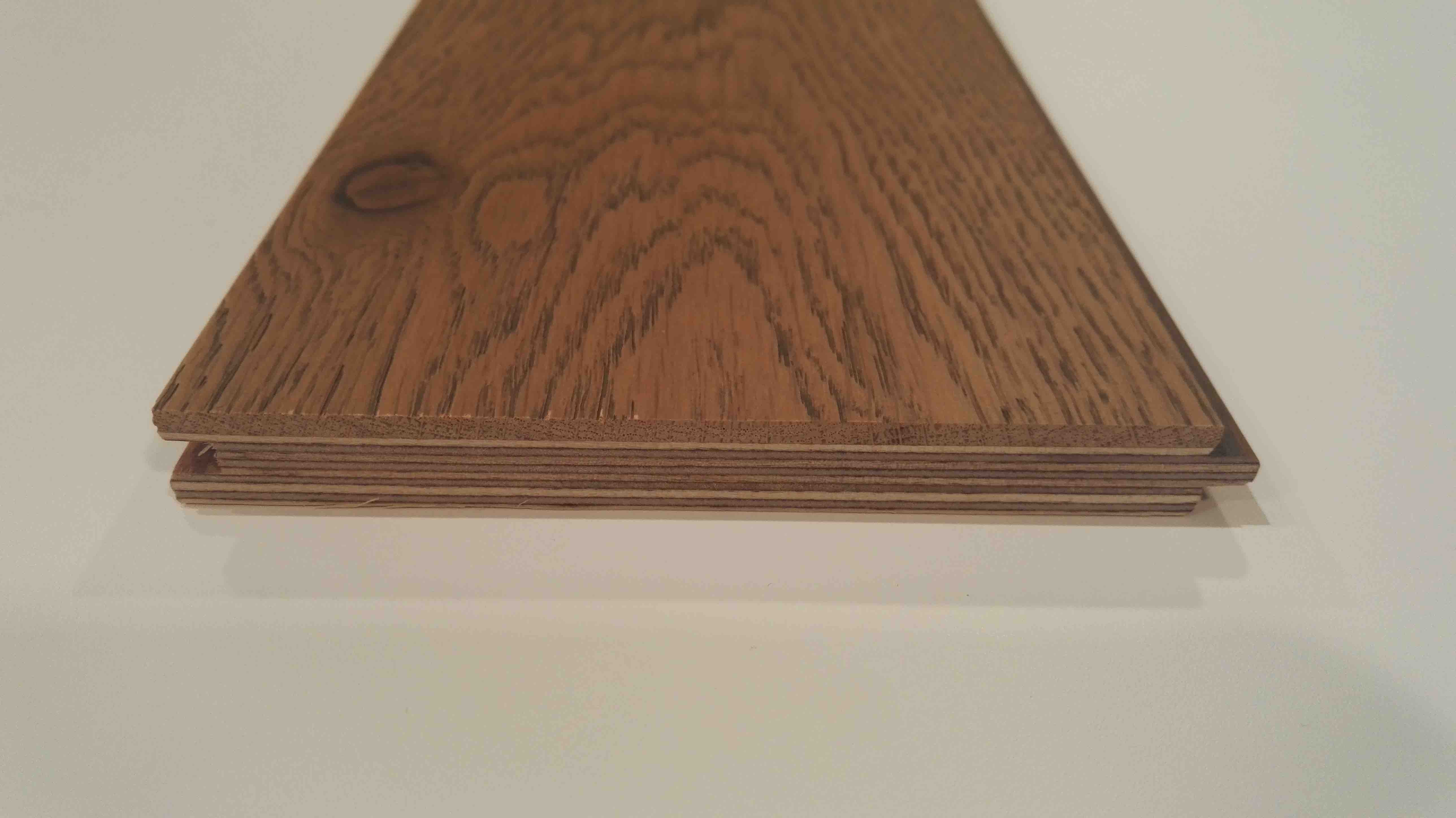
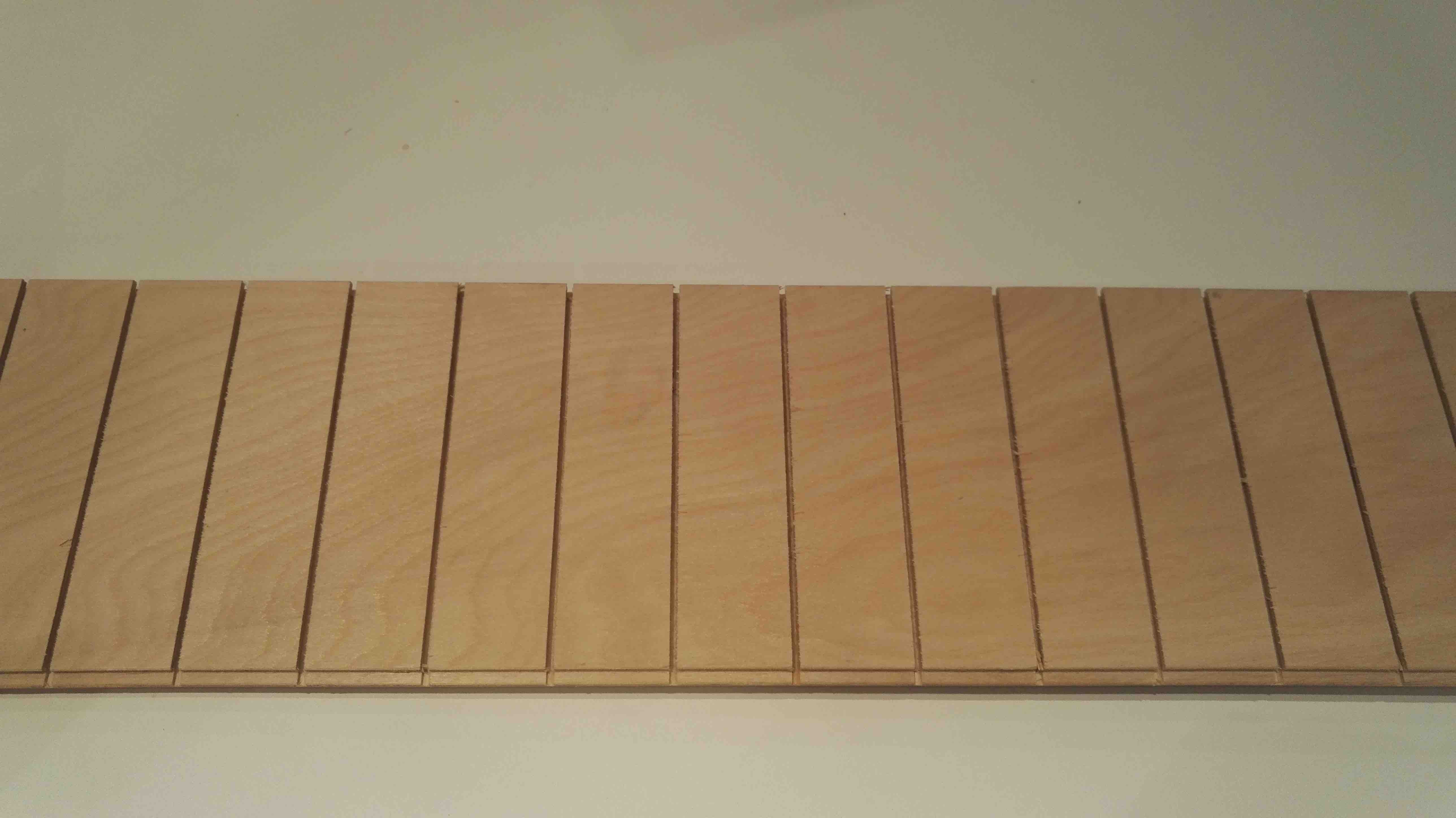
The stability of parquet flooring can be achieved in several ways. The most traditional method is the use of a laminated support with cross-oriented fibers (also known as multilayer construction), which distributes the stresses generated by the wood fibers evenly in all directions.

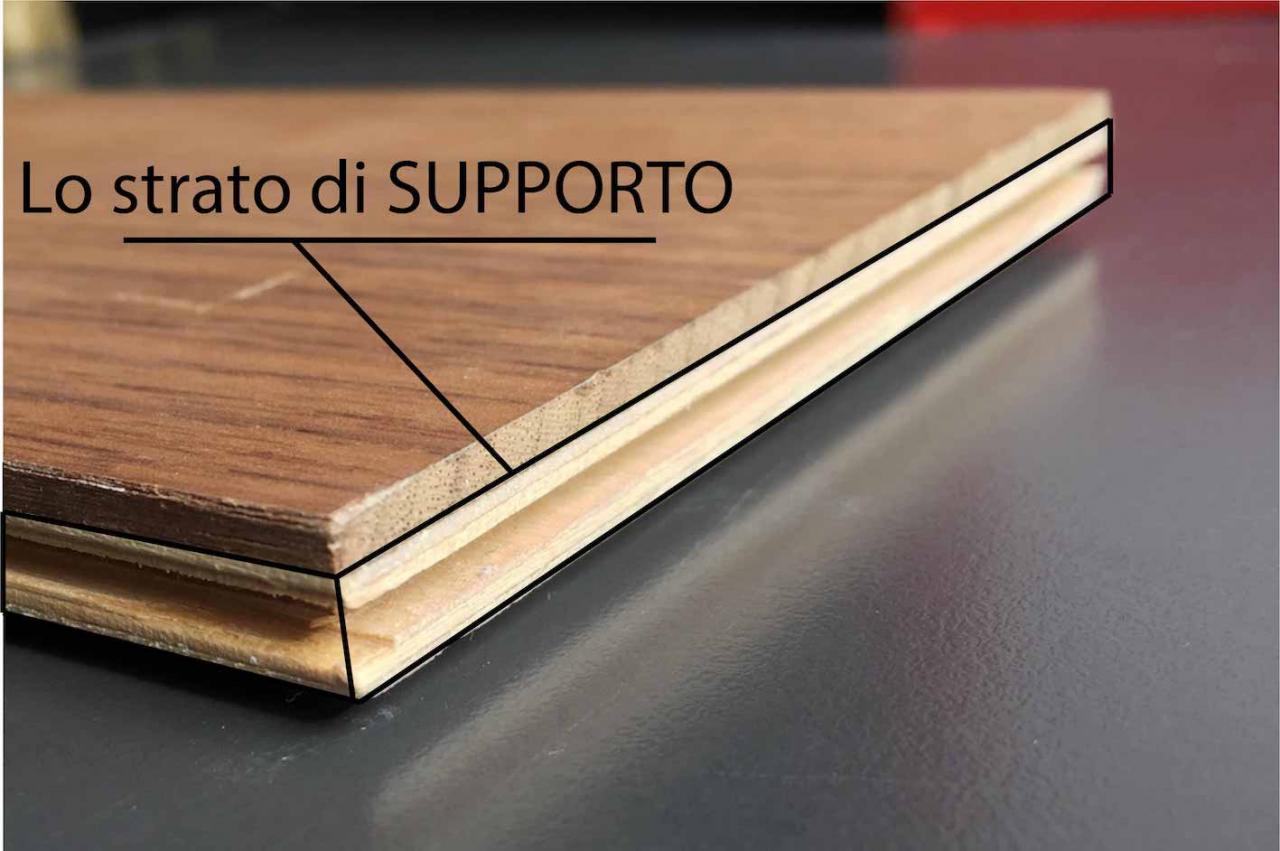
A “wood wafer”
A support layer with cross-laminated veneers has a characteristic striped cross-section—often described as a wafer—where the various layers of wood are bonded together, typically using phenolic adhesive.
This support layer is usually manufactured by companies specialized in this specific semi-finished product (although in some cases it is produced in-house by the parquet manufacturer).
In any case, it is essential that the support layer complies with E1 (Class A) standards regarding formaldehyde emissions and is PEFC/FSC certified, ensuring the responsible sourcing of the wood.

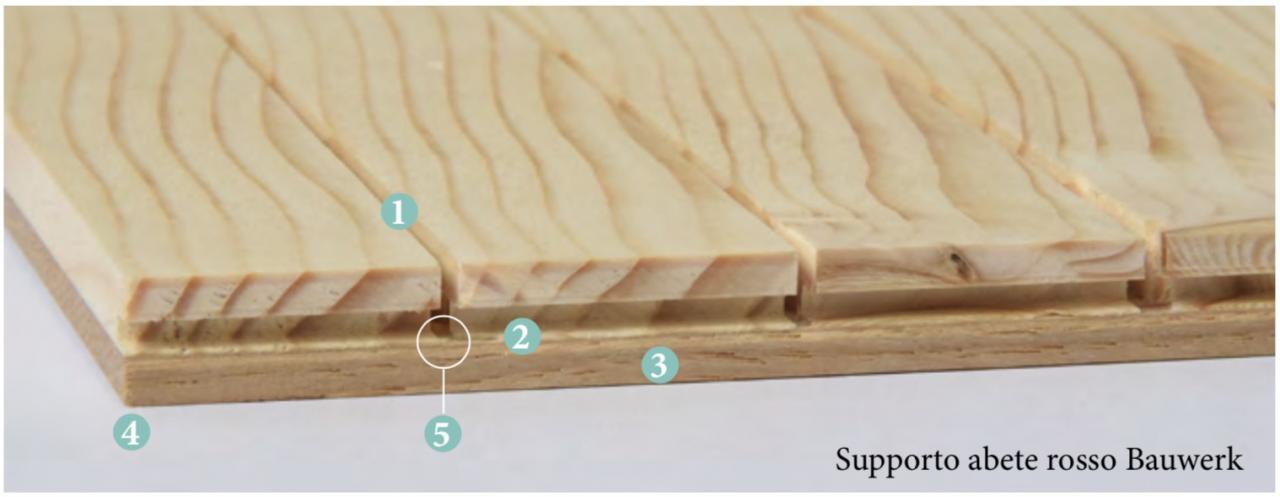
Wood species used
The two most commonly used wood species for manufacturing this type of support layer are fir and birch, with birch generally preferred over fir due to its superior technical performance. The support layer typically has a thickness of 5 to 8 millimeters.
This support layer is then bonded to the wear layer, again using adhesives that do not release harmful substances.
Total thickness and price
Bonding the wear layer to the support allows the finished product to reach a total thickness ranging from 10 mm to 14 mm. The greater the thickness, the higher the cost of the product. However, it should be emphasized that price is also strongly influenced by the type of support used: the most economical solution is a single-layer fir support; a better solution is a fir plywood support; and the most expensive—but also the best-performing—solution is a birch plywood support.
Wear layer and support: a delicate balance
Why is the support layer so important?
The two-layer engineered construction involves a delicate balance between the internal stresses of the wear layer and the stabilizing action performed by the support layer. Not only that—the support must also provide sufficient mechanical strength to withstand the stresses applied to the upper walking surface.
In short, the role of the support layer is to ensure stability, strength, and long-term durability of the flooring.
Available sizes for engineered multilayer wood flooring
Thanks to multilayer construction, today we have access to a much wider range of sizes than those traditionally available with solid wood flooring.
Sizes range from the increasingly less-used 70 × 700 × 11 mm strip, to the elegant plank format 90 × 1000 × 11 mm, the maxi-plank 135 × 1400 × 11 mm, and the larger boards now preferred for living areas—true wide planks with dimensions ranging from 160 × 1900 × 11 mm up to 200 × 2100 × 11 mm.
This list of sizes is not exhaustive and can vary significantly depending on the manufacturer.
Engineered wood flooring: which support layer should you choose?
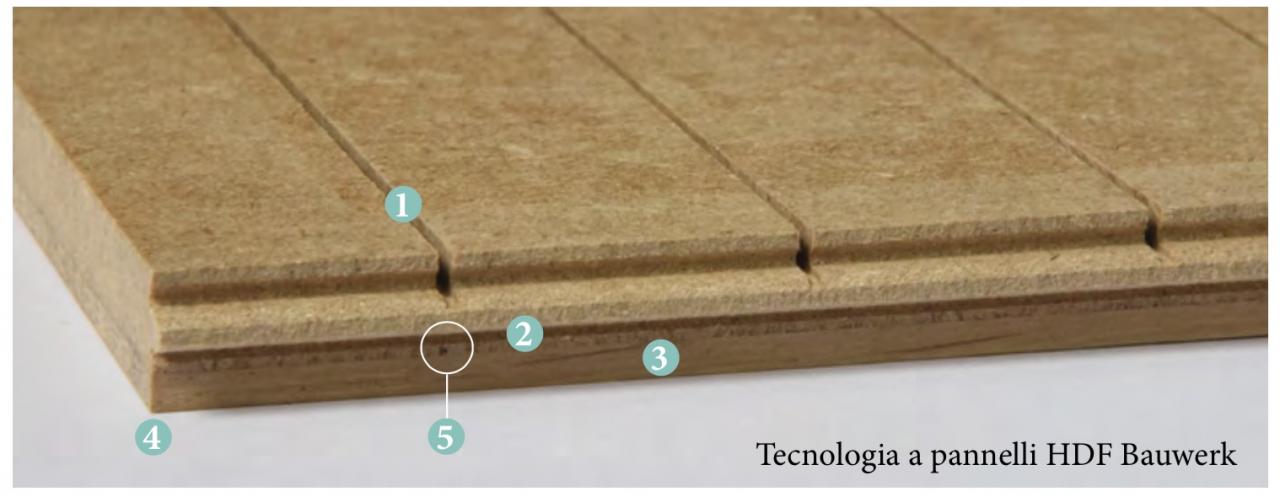
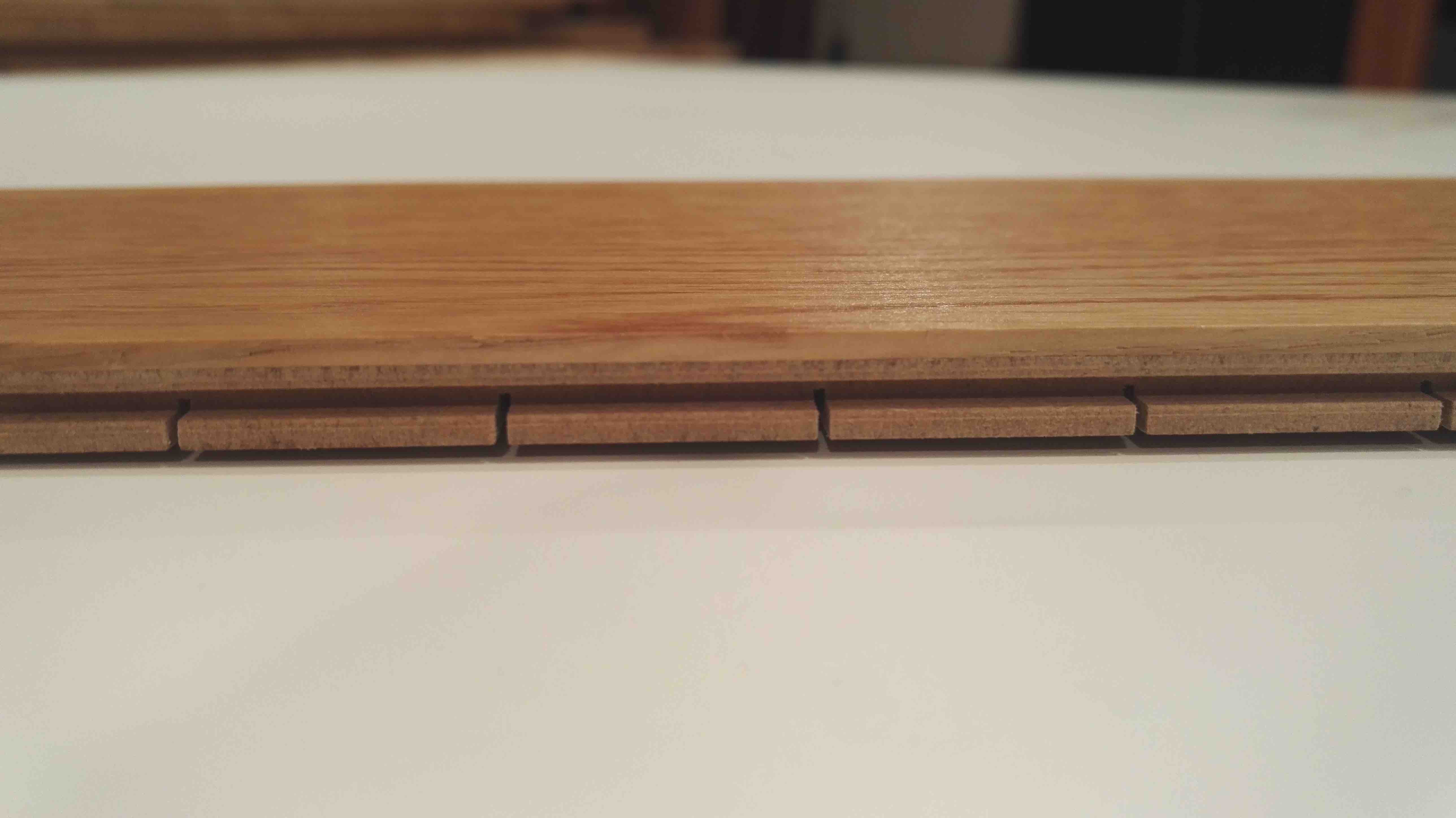
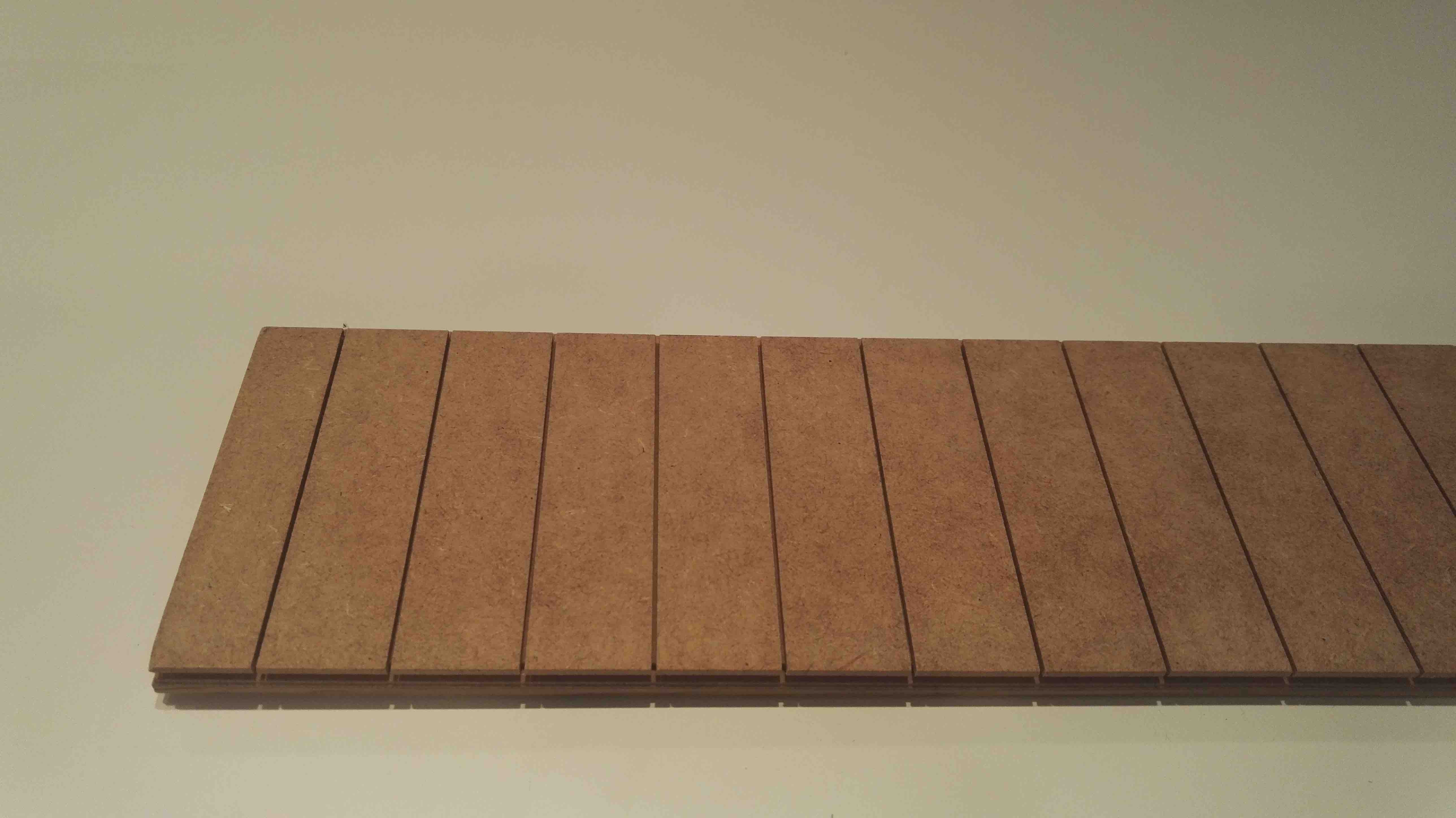
In recent years, a second type of support layer has been developed: HDF (High-Density Fiberboard). This high-density panel is made of wood fibers compressed under high pressure. HDF panels must comply with the same regulations as plywood panels and therefore must be E1 class certified.

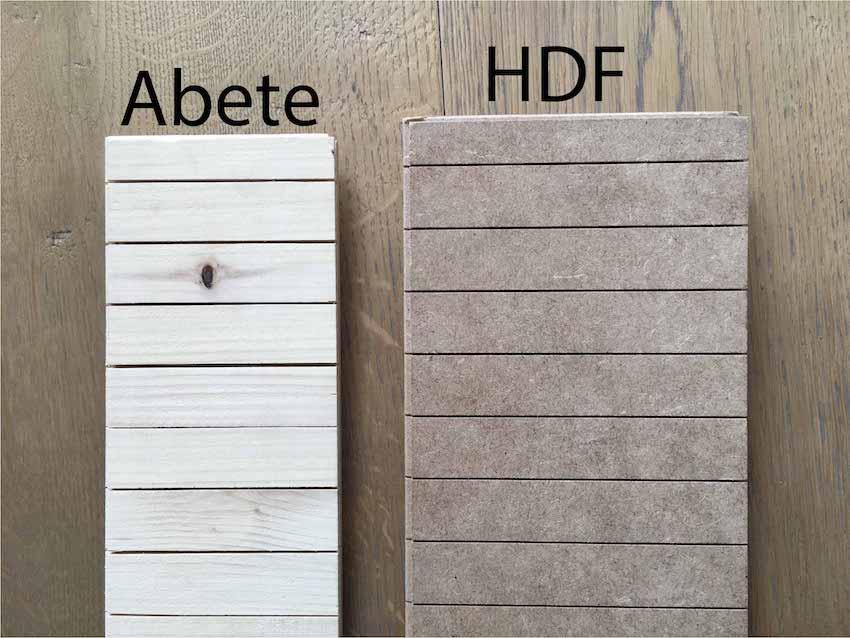
The high-density fiber support has introduced several improvements: the overall thickness of the flooring has been reduced to 9–10 mm while maintaining the same board widths as the previous solutions. In addition, it offers better performance with underfloor heating systems, because HDF, being a denser material, has higher thermal conductivity and therefore allows heat to pass through more efficiently and evenly.
HDF is also far more resistant to moisture than any other type of support layer: even when immersed in water for several hours, it shows no dimensional changes.

How to choose engineered wood flooring
Selection criteria
If we take it for granted that engineered wood flooring is now the most commonly used solution for wooden floors, what are the criteria for choosing the right engineered product?
Of course, attention will be paid to the wear layer, the wood species, and the preferred finishes and surface treatments. One must also consider the desired protective treatment (oil or varnish) and the grading of the parquet, topics that are discussed in other articles on this blog.
However, great importance should also be given to the support layer, which must be chosen according to specific needs. Let’s look at a few examples.
HDF support
The new HDF support layer should be preferred when a reduced thickness is required to meet building compliance regulations, in the case of underfloor heating thanks to its better thermal conductivity, or in situations where there is light but latent moisture.
An example of the latter is when engineered flooring needs to be glued over an existing ceramic floor on the ground level of an older house without a basement and lacking insulation or ventilated layers beneath. In this case, HDF—being less affected by moisture—is the preferable solution.
FIR support
Fir support, used in two-layer engineered parquet, can be either solid or multilayer (i.e., several layers of fir bonded together). Fir represents a traditional solution deeply rooted in the history of parquet flooring. It is a lightweight, natural material with good hygroscopic behavior, making it attractive from an economic standpoint due to its generally lower cost, though it is more sensitive to variations in humidity and temperature.
Its reliability strongly depends on the quality of the selected wood, proper seasoning, and the type of adhesive used.
BIRCH support
Birch support (almost always in the form of birch plywood) is today considered one of the most technically reliable solutions for two-layer engineered parquet. It consists of multiple thin layers of birch cross-laminated together, a structure that ensures excellent dimensional stability and minimizes wood movement over time.
Thanks to its mechanical strength and predictable behavior—even with underfloor heating—it represents the ideal choice for those seeking high performance, durability, and safety, albeit at a higher cost compared to traditional supports. Birch plywood is, in fact, the most expensive support layer available.
Engineered wood flooring: defects and potential issues
Like any material, two-layer parquet can also present certain issues that should be taken into account.
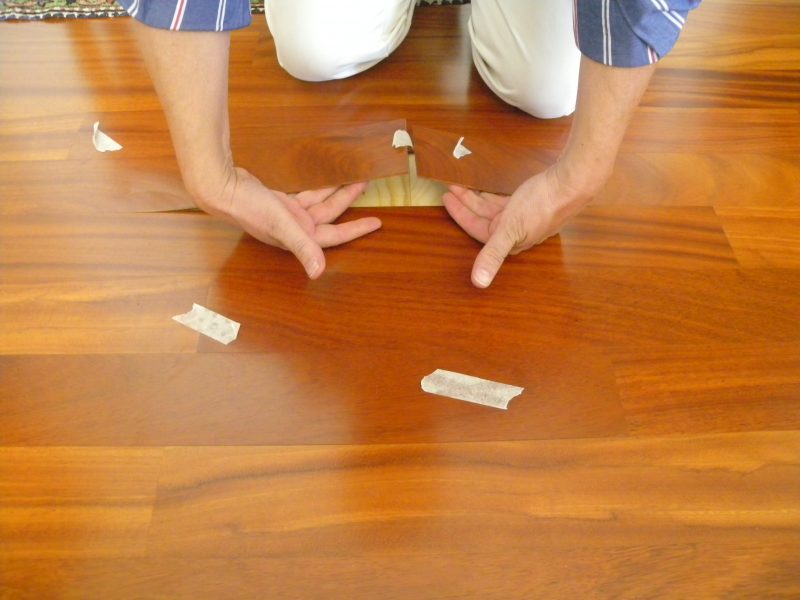
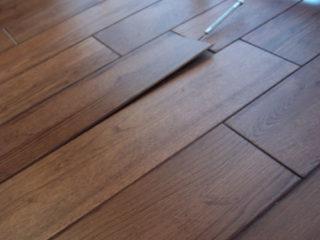
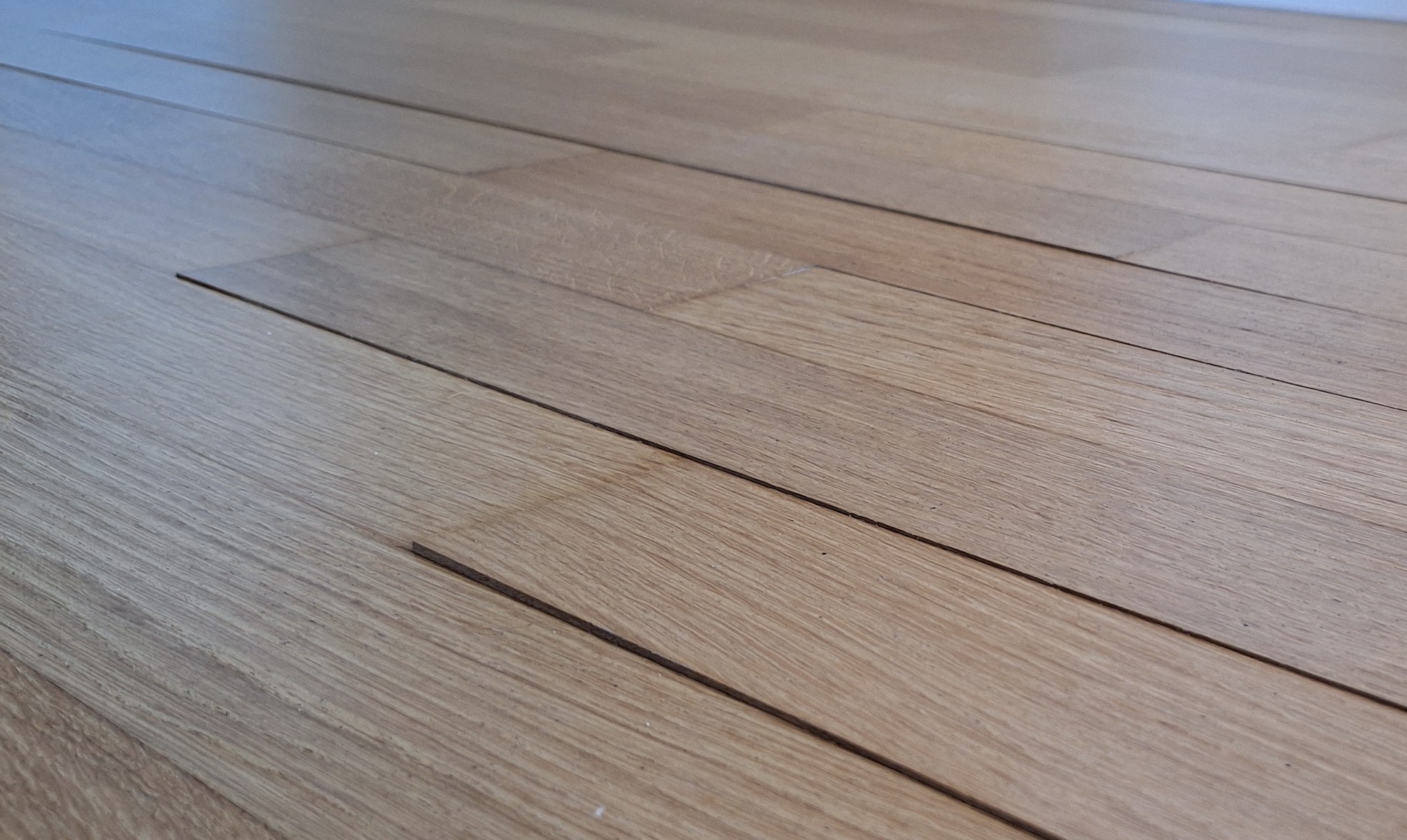
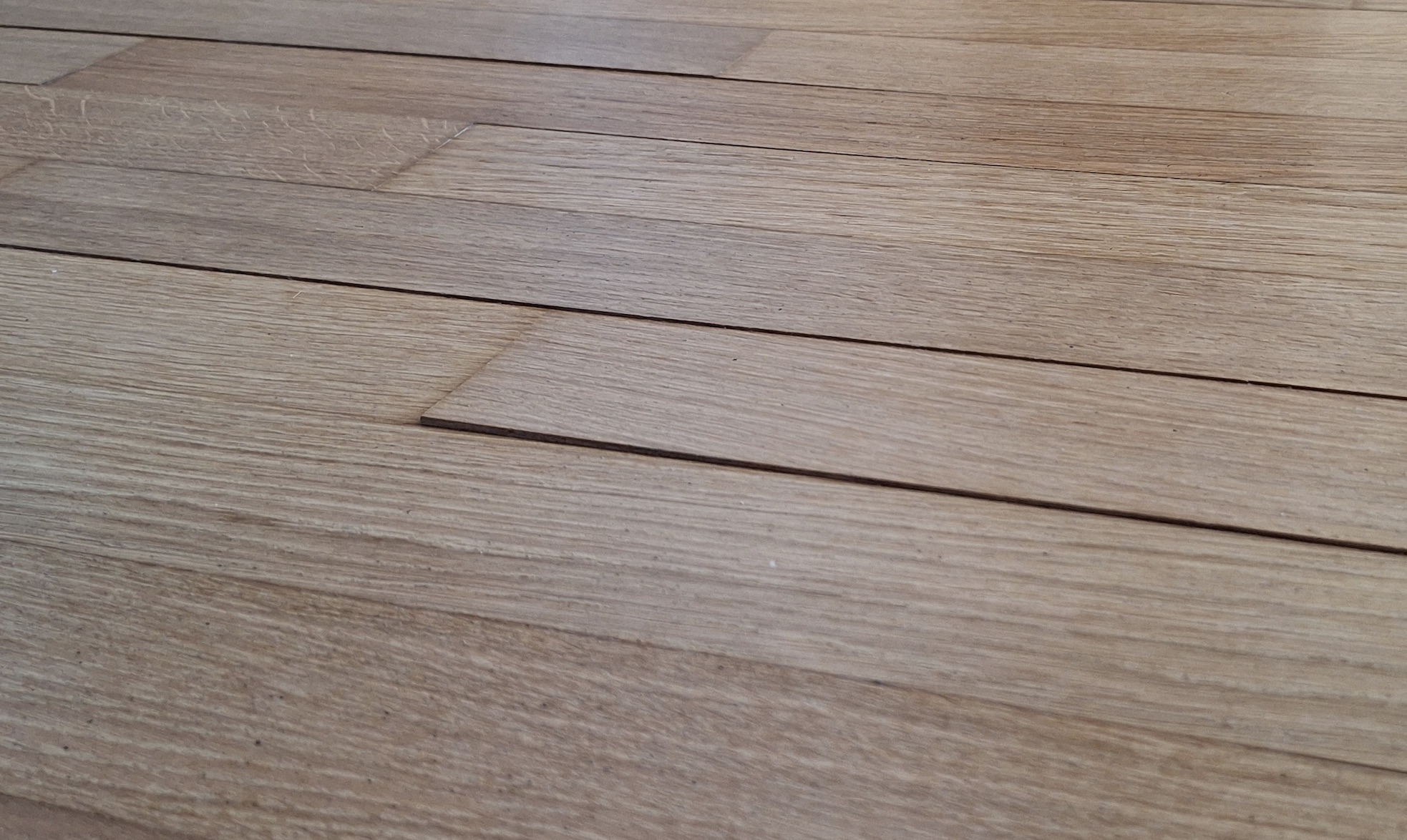
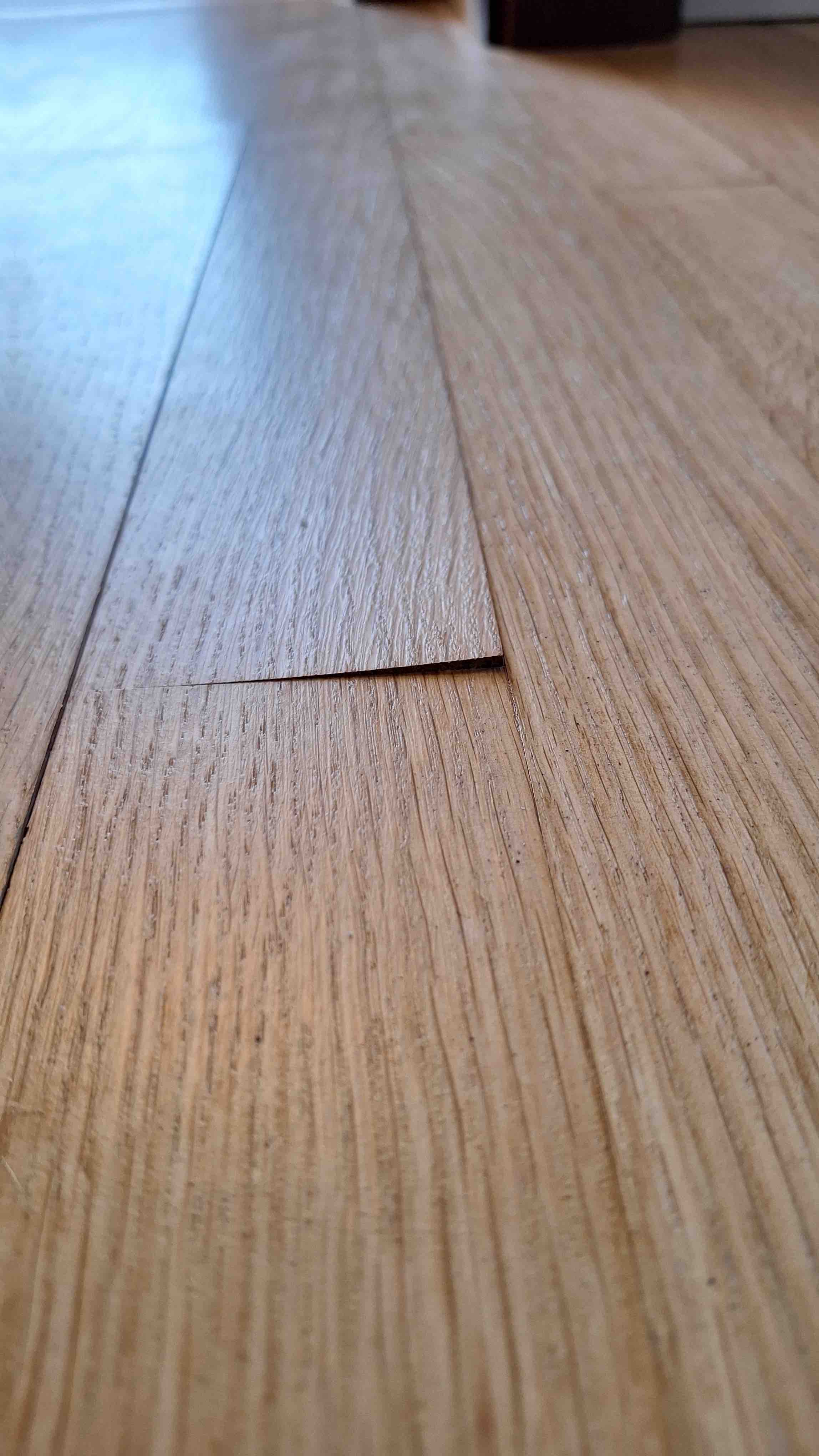
If the wear layer is not properly bonded, or if after installation it is subjected to excessive tensile stress, delamination may occur—that is, a partial or complete separation of the top layer from the support layer.
To learn more about delamination, please read this FAQ: “Engineered flooring has delaminated!” ->->

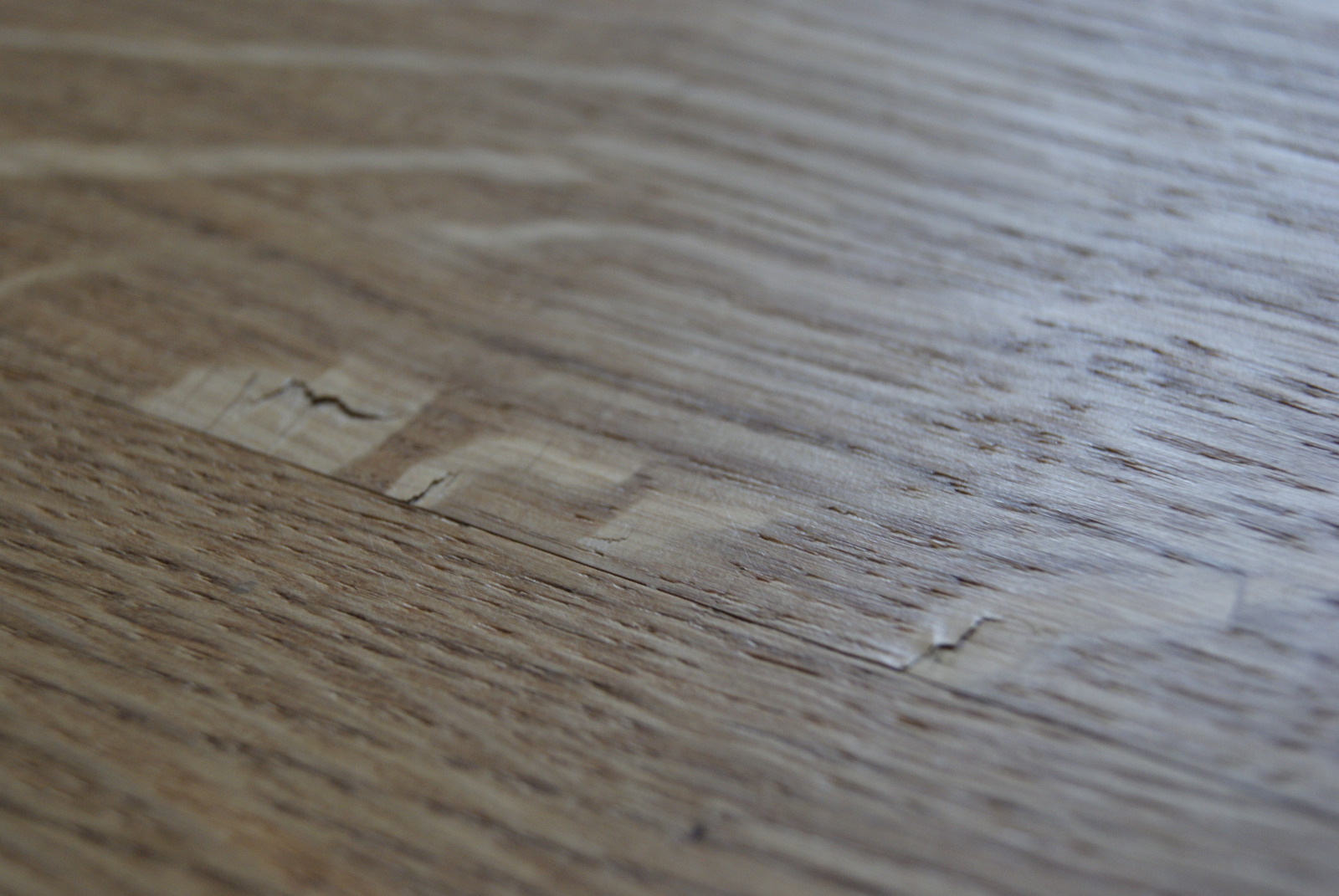
Another issue may arise if the wood suffers damage due to a dent or a strong impact, resulting in a significant lesion. In such cases, the thickness of the wear layer may not be sufficient to conceal the damage, and the lesion can reach the support layer, revealing—in some instances—a noticeably different color underneath.

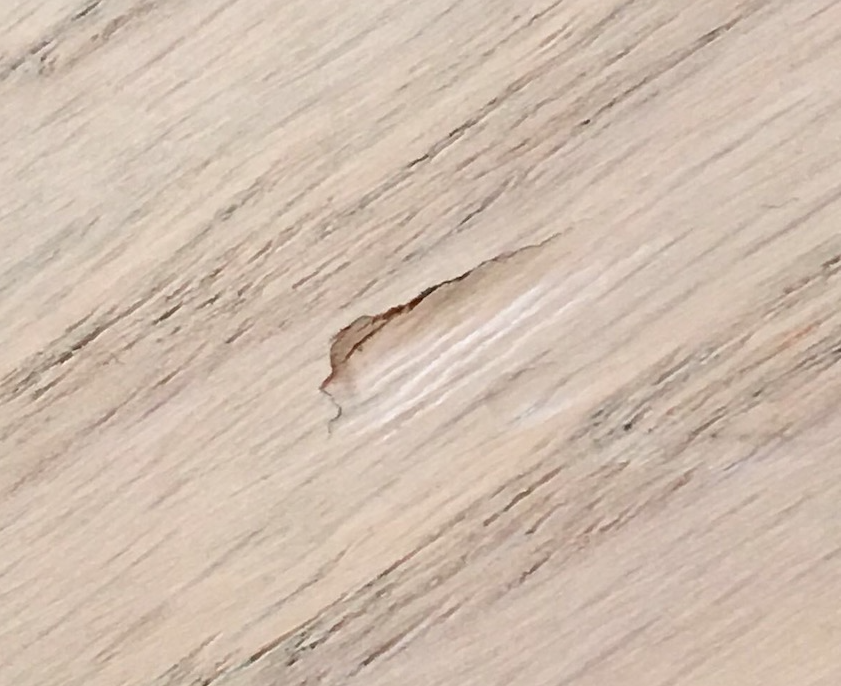
Esempio di problemi che si possono presentare in un parquet prefinito
Thank you!
Thank you for reading this article—I hope you found it interesting.
Below you’ll find the links to contact us. Please keep in mind that we are a small company, a team of interior designers who always work with custom-made projects that we then bring to life.
We specialize in surfaces, bathrooms, and kitchens, and in these three areas we always strive to find the right tailor-made solutions for you. We work with Made in Italy products and continuously select the best manufacturers in order to offer you top-level quality in the world of finishes.
We also provide a range of services that are included in the price, such as professional consultation, custom design solutions, site inspections, and on-site assistance during installation.
Write to us at info@fratellipellizzari.com or call one of our showrooms to book an appointment.
See you soon!!

Commenti
Buonasera ,
sto decidendo il tipo di pavimento per una mansarda posta al terzo piano con riscaldamento a pavimento… amo il parquet e non il gres effetto legno.. mi hanno proposto di mettere un prefinito multistrato con betulla… il listone piccolino che verrà incollato…la mia preoccupazione è che mettendo il parquet io abbia difficoltà a riscaldare la casa in quanto il legno so che potrebbe essere isolante del calore e non consentire la dispersione del calore per irraggiamento…. vorrei chiedere a voi se posso avere problemi o invece il parquet è preferibile al gres proprio per mantenere calda la casa…. essendo una mansarda mi preoccupo un po'… poi sarebbe meglio preferire hfd betulla o abete.. (a me hanno proposto l'abete)… ed in ultimo come faccio a verificare se la colla che usano per la posa del parquet è quella ecologica e non quella ricca di forlamdeide??
vi chiedo di rispondermi quanto prima visto che io devo scegliere a breve il tipo di pavimento. inoltre visto che il passo per il sistema radiante è più corto vorrei capire che facendo più serpentine a causa del parquet io possa spendere di più a livello dei consumi
Buongiorno Maria Luisa,
grazie per aver letto l'articolo e per la domanda.
Iniziamo dalla prima preoccupazione: certamente il legno è un isolante per cui il calore fa un pochino più fatica a passare rispetto ad un pavimento in grès effetto legno, ma passa. L'importante è non esagerare con gli spessori: un listoncino piccolo, come quello visto da lei, a due strati e di basso spessore (solitamente 10 mm.) va benissimo. Sicuramente spenderà un po' di più (il suo termotecnico le può anche calcolare la differenza) ma non così tanto da esserne preoccupata.
Sul tipo di supporto: io consiglio decisamente l'HDF che rende più stabile il sistema. In secondo luogo il multistrato di betulla (solo se di origine nord-europea!) mentre sconsiglio l'abete.
Sulla qualità dei materiali, tipo di colla, ecologia... le consiglio di utilizzare Bauwerk, produttore svizzero. Ho visitato personalmente lo stabilimento e le posso garantire che hanno un rispetto incredibile e meritevole per gli aspetti ecologici ed ambientali. Non so da dove mi stia scrivendo ma hanno rivenditori in moltissime zone d'Italia: cerchi sul sito di Bauwerk se c'è un negozio nella sua zona.
In alternativa, se non trova Bauwerk, pretenda che il prodotto sia made in Italy (le norme sull'uso di prodotti chimici sono più rigide da noi che in altri paesi) e se possibile VISITI lo stabilimento produttivo. Questo perché - purtroppo - ci sono un sacco di "finti produttori" che magari fanno una singola lavorazione e spacciano il prodotto come italiano. Per esempio qui a Vicenza ce ne sono almeno tre che si limitano a fare l'oliatura o la verniciatura su tavole di provenienza cinese e poi vendono il prodotto come made in Italy e poi scrivono "risparmia comperando direttamente dal produttore". Ma il risparmio è, chiaramente, dovuto ad altri fattori...
grazie ancora per averci consultato,
buona giornata
Buongiorno ho letto il suo articolo in Internet e volevo chiederle siccome devo fare posare del parquet a casa mia , del prefinito con il supporto in hdf. È adatto come collante la colla silanica ?????
Buon giorno Ezio
Grazie per la tua attenzione
Certo il supporto hdf è adatto anche alla silanica monocomponente, noi cerchiamo sempre di utilizzare i prodotti migliori presenti sul mercato, nel tuo caso userei la Kerakoll SLC eco L34 flex, bio compatibile e adatta anche a pavimenti riscaldati.
Grazie ancora e buona giornata
Roberto
Buongiorno Sig. Ezio,
mi hanno proposto per un pavimento con riscaldamento a pavimento, un parquet triplo strato da 18mm listone Giordano in rovere mentre un palchettista, mi ha suggerito un triplo strato Mardegan da 15mm in quanto dice che 18mm sono troppi.
Corrisponde a verità tutto ciò?
Mardegan può competere a livello di qualità con Giordano?
N.B.: Il Mardegan propostomi ha 5mm di legno nobile mentre il Giordano solamente 3,5mm.
Grazie e distinti saluti.
Pier
Gentile Sig. Pier,
Concordo con il posatore: non ci si deve fermare al Brand ma bisogna analizzare bene il prodotto. Mardegan fa un ottimo prodotto (noi non lo teniamo perchè non è Made in Italy, viene fatto in Ungheria, ma il prodotto è ottimo). Inoltre concordo con il posatore anche sullo spessore: 15 millimetri vanno bene, 18 sono troppi.
Buona giornata
Buonasera, ho un problema di delaminazione della parte nobile del parquet prefinito, cercando sui vari forum in materia, ho trovato il vostro sito web molto interessante oltre ad essere uno dei pochi che parla di questi problemi.
Il montaggio è avvenuto ormai da molti anni, circa 15/16 e questo problema si è verificato in una piccola parte di un ambiente mentre in altri tre è tutto a posto.
Il supporto del parquet installato è in abete.
Vorrei fare un tentativo nell'incollare la parte nobile al supporto, vorrei chiederVi un consiglio in merito. Che tipo di colla conviene usare? Non penso che la classica vinavil possa andare bene o mi sbaglio?
Rimango in attesa di un vostro riscontro, Vi ringrazio in anticipo del tempo che vorrete dedicarmi.
Colgo l'occasione per porgere cordiali saluti.
Massimo L.
Buonasera Massimo,
ti sconsiglio di attuare un intervento "fai da te", è meglio rivolgersi ad un posatore di legno che ti potrà garantire un miglior risultato. In ogni caso noi utilizziamo una colla vinilica molto simile alla vinavil.
Grazie per la domanda e per aver letto l'articolo!
Buongiorno sig. Ezio,
sto ristrutturando una casa degli anni 50 e, poiché gli impianti sono stati rifatti ex novo, il massetto dovrà essere anch'esso rifatto, la ditta che sta realizzando i lavori mi ha detto che loro non fanno il massetto autolivellante e che volendo io posare un parquet( appena acquistato un formpark spina ungherese rovere mandorla, spero di aver scelto bene, visto che mi è stato venduto come un prodotto di qualità eccellente, pur avendo di legno nobile solo 2.5mm e uno strato di supporto in HDF e non betulla!) avrei dovuto far colare l'autolivellante dal posatore. Quest'ultimo mi risposto che se la ditta realizza un buon massetto "ben fracassato", non ci sarà alcuna necessità di colarvi sopra un autolivellante. Lei mi conferma quanto detto dal mio posatore e mi potrebbe spiegare qual è il miglior massetto da realizzare per la posa del suddetto parquet da me scelto.
La ringrazio e le auguro una buona domenica
Buongiorno Tiziana,
come spesso scrivo nei miei articoli (ed anche i miei colleghi lo dicono) è assolutamente sbagliato affidare massetto e posa dei pavimenti a due ditte diverse. In caso di problemi dovrai sorbirti uno scaricabarile ed anche legalmente non sei molto tutelata. Per una migliore garanzia del risultato finale ed una migliore tutela legale ti consiglio:
Questa semplice dicitura ti sarà utilissima in caso di future problematiche e, legalmente, sarai in una botte di ferro. Inoltre perderai molto meno tempo perchè l'interlocutore unico che scegli avrà tutto l'interesse a fare il lavoro nel migliore dei modi, senza che tu debba interessarti a destra e a manca su quale sia la soluzione migliore.
Per cui evita di assumerti questa responsabilità ed incarica una singola azienda di tutto il lavoro.
Spero di essere stato chiaro, grazie, ciao!
Dovrei posare un multistrato sopra un impianto a pavimento,vorrei sapere se andrebbe bene anche un pavimento"gallegiante",e se tra massetto e laminato deve essere interposto un telo.Grazie
Ciao Francesco,
si, su un impianto di riscaldamento a pavimento puoi posare anche un pavimento in legno (o in laminato) galleggiante o, come si dice, flottante. E si, è necessario interporre un materassino compatibile con il riscaldamento a pavimento.
Trovi altre informazioni qui:
https://www.fratellipellizzari.it/blog/legno-flottante-o-incollato
Ciao!
Buongiorno!
Esiste un massetto specifico per un pavimento in legno prefinito?
Ci sono massetti da sconsigliare?
Grazie
Ciao Davide,
abbiamo parlato dei massetti per il parquet in legno qui:
https://www.fratellipellizzari.it/blog/posa-legno-massetto
Non c'è un massetto specifico per prefiniti oppure un massetto che va bene sempre ed un altro che è sempre sconsigliato, ma in genere è preferibile un massetto tradizionale (sabbia e cemento staggiato a mano) rispetto ad un autolivellante (che spesso richiede l'applicazione del primer). Però, ripeto, non è una regola che vale sempre: bisogna vedere da caso a caso.
ciao!
Grazie molto gentile..approfitto per un ulteriore chiarimento.. ma invece lo spessore di un prefinito incide anche sulla sua qualità e sul suo valore? Cioè investire una cifra maggiore per uno spessore maggiore (da 10mm a 15 per esempio) ha senso?
Ciao Davide,
La tua è una domanda molto interessante e richiederebbe un approfondimento maggiore di quello che sto per scrivere. In estrema sintesi, quindi, ti scrivo che lo spessore di un prefinito non è necessariamente indice di qualità: occorre esaminare la stratigrafia del prodotto. Ci sono prodotti da 10 millimetri che sono più validi (e costosi) di altri da 15 mm.
Se lo spessore 15, ad esempio, viene ottenuto sovrapponendo strati di abete otterremo un prodotto di qualità medio-bassa. Ma se lo stesso spessore viene ottenuto controbilanciando lo strato superficiale di legno nobile con un altro strato di legno nobile nella parte bassa del prefinito (a contatto col massetto), otterremo un prodotto di qualità molto più elevata.
Se vuoi passa a trovarci in negozio così approfondiamo meglio la questione,
ciao!
Buonasera,
scrivo per chiedere consigli per la scelta del parquet prefinito da posare in casa (circa 80 mq commerciali), da posare ovunque (compresi bagno e cucina). Ho riscaldamento con termosifoni.
Mi piace il rovere colore naturale con nodi.
Attualmente ho le seguenti proposte:
Se sapete darmi consigli, informazioni, indicazioni ne sarei enormemente grata!
Conoscete queste aziende? Sapete darmi consigli in merito? Sono prodotti di qualità (non asiatici)?
I prezzi sono corretti?
Oliato o verniciato? Quale il migliore? Cosa vuol dire verniciato olio UV? 2 strati o 3 strati? Cosa pensate del supporto HDF?
SKEMA
- rovere aida rock: 3 strati, 15 mm di cui 4 nobile. vernice olio UV - 45 €/mq - 1900x190x15
BAUWERK
- CASAPARK rovere 181 scelta 45, 3 strati, 14 mm di cui 3,5 nobile (verniciato opaco o olio naturale... non so quale dei due mi è stato proposto) - 56 €/mq - 181, 2200 ⨉ 181 ⨉ 14 mm --> Non ho capito il tipo di legno/materiale degli strati di supporto, voi lo sapete?
- VILLAPARK rovere scelta 46, 2 strati, oliato, 9,5 mm di cui 2,5 nobile, - non so ancora prezzo - 2100 ⨉ 190 ⨉ 9.5 mm --> secondo strato in HDF
- VILLAPARK rovere scelta 35, 2 strati, oliato, 9,5 mm di cui 2,5 nobile, - non so ancora prezzo - 2100 ⨉ 190 ⨉ 9.5 mm --> secondo strato in HDF
SALIS
- country gent/natural , 3 strati, oliato, 14 mm di cui 3,5 nobile - 45,6 €/mq - 138x1100/2200x14
- pretty wood/loto, 3 strati, oliato, 12 mm di cui 3 nobile - 54,15 €/mq - 158x900/1830x12
- pret a porter multistrato betulla 180/190x1000/2000x14 (di cui 4 nobile) spazzolato e verniciato ad acqua, bidellato - 50 €/mq
WOODCO
- DREAM rovere naturale oliato, scelta SPIRIT, 15 mm di cui 4 nobile - circa 70/78 €/mq (in attesa prezzo finale) - (credo) 1400/2200 x 180 mm
Grazie mille
Ciao Stefania,
difficile darti una risposta completa qui, per cui in estrema sintesi direi che il miglior rapporto qualità/prezzo tra i prodotti che mi hai descritti è il CASAPARK rovere 181.
Sono un po' perplesso sulla scelta che hai individuato e cioè sulla 45: tieni presente che avrà molti nodi ed anche presenze di alburno. Deve piacerti, insomma, un effetto finale piuttosto rustico.
ciao!
Ho necessità di pavimentare un negozio commerciale per 140 mq. con medio-alto ingresso di clienti.
Sulla base dei costi e della durabilità del prodotto quale materiale scegliere.
Grazie
Pasquale
Ciao Pasquale,
io ti consiglierei il Bauwerk nella versione "vernice b-protect" che ha un ottimo rapporto qualità-prezzo ed una verniciatura molto resistente.
ciao!
Salve,
conoscete la falegnameria MEG Trading?
Importa dalla cina la collezione caraibi...
Sapete se è di una qualità accettabile?
Grazie
Andrea
no, non la conosciamo. Ma perchè mai vuoi acquistare un prodotto cinese? Siamo i più bravi al mondo a produrre pavimenti in legno: in Italia i processi controllati, i parquet sono sicuri per chi li lavora e per chi abiterà nella casa; il legno è più selezionato e bello. E poi pensa all'inquinamento che si produce con il trasporto via nave dalla Cina a qui. E se scegli il Made in Italy darai lavoro a famiglie italiane.
Ciao!
Buonasera approfitto della vostra disponibilità, conoscenza e specializzazione in materia per sottoporvi un problema in un appartamento che sto ristrutturando. Nella forsennata ricerca di un prodotto che potesse sposare le richieste del cliente , ci siamo imbattuti in un parquet stratificato a due strati con incastro m/f . IL venditore certifica il prodotto come "Teak massiccio giuntato" (Teak Asia -Tectona Grandis) 10mm di cui 3 parte nobile ; massiccio appunto per il supporto che anch'esso è composto da listelli di teak meno pregiati. Il quesito nasce sull'opportunità di usare questo tipo di supporto. Ritenete abbia una buona prestazione termica per posa su impianto radiante ? Ci sono maggiori rischi di "delaminazione" visto che trattasi di due materiali uguali? I valori certificati sono:
-Conduttività termica parte nobile (con massa volumica pari a 700 kg/mc ±10%) : 0,170 W/mK
-Conduttività termica del supporto : 0,059 m 2K/W
Grazie per la risposta e quanto prima verremo a visitare i Vs. showroom
il materiale che descrivi ha una struttura che non conosciamo, probabilmente è di manifattura non italiana.
La conducibilità termica λ che nel S.I. si misura in watt al metro-kelvin è la capacità del legno di condurre il calore: più è elevata e più il materiale è in grado di far passare il calore dal sistema radiante agli ambienti.
Venendo al valore che ci segnali di 0,17 per la parte nobile in teak: tale valore è soddisfacente ed allineato a quello di altri legni utilizzati per la pavimentazione, come il Rovere (0,16) o il Doussiè (0,19).
Il teak, inoltre, offre una migliore stabilità dimensionale rispetto alla media dei parquet utilizzati per pavimento, questo significa che non soffre moltissimo gli sbalzi di umidità e temperatura.
Credo ci sia un errore, invece, nel valore che ci segnali della conduttività termica del supporto in quanto il valore è troppo basso e l'unità di misura non è quella corretta. Deduco si tratti della Resistenza termica, che si indica con R = d/λ (espressa in m² K/W) che ha un significato opposto rispetto alla conducibilità.
In ogni caso non conoscendo il prodotto ed avendo dei dati non certi mi limito a darti alcuni suggerimenti:
1. se scegli un produttore italiano (o tedesco o austriaco o francese) sarai garantito sul rispetto di norme severe in fase di produzione ed utilizza prodotti chimici che rispettano l'ambiente, i lavoratori ed i clienti finali;
2. la scelta di un produttore conosciuto sarà in grado di garantire anche le tempistiche di lavorazione (asciugatura ed essicazione dei legni) che sono importantissime per evitare conseguenze sul parquet dopo la posa, uno dei quali è proprio la delaminazione che ci segnali;
3. il teak proveniente dalla Birmania non dovrebbe nemmeno essere acquistato in quanto frutto di un traffico illegale che ha come effetto l'annientamento della foresta primaria. Se vuoi saperne di più leggi: Il traffico di legno tropicale di teak
4. la scelta di fornitori "esotici", attirati dalla italianissima perenne convinzione di fare un "affare", si rivela quasi sempre controproducente, specie per acquisti impegnativi come un pavimento. Paese strano il nostro: la quasi totalità della produzione di eccellenza italiana di parquet viene comperata da stranieri che apprezzano il nostro operato, mentre noi, inspiegabilmente, scegliamo la bassa qualità del sud est asiatico.
Grazie, ciao!
Aggiungi un commento